
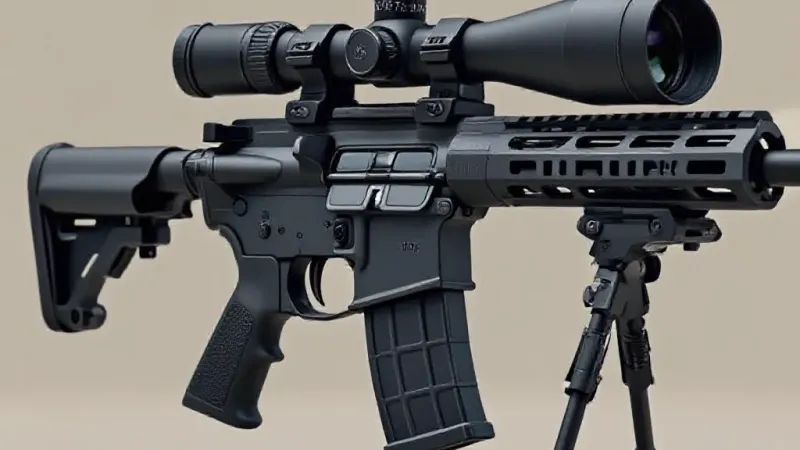
The US Army M24 Sniper Weapon System (SWS) has maintained service since 1988, a testament to its foundational design. Despite its three and a half decades of use across various militaries, the original platform shows its age. Efforts by the US Army to update the M24, such as the XM24A1, M24A2, M24A3, and the 2010 M24E1, largely focused on cartridge upgrades—moving from 7.62x51 to .300 Winchester Magnum and .338 Lapua Magnum—with only the M24E1 incorporating a chassis system.
In 2019, the Israeli Defense Force (IDF) pursued a different modernization path, partnering with MDT to develop a dedicated chassis as the centerpiece of their IDF Modernized M24 SWS program. The IDF's strategy was direct: replace the original fiberglass stock with an MDT chassis, upgrade the optic and its mount, and add a muzzle brake. This approach aimed to inject new life into the legacy system, preparing it for contemporary operational demands. Observations of service rifles also suggest that a barrel reset and re-chambering process was undertaken, indicated by inverted caliber markings on some barrels.
The core of this modernization is the MDT chassis, designed to address the limitations of the original fiberglass stock, particularly in scenarios beyond static range conditions. While the M24's accuracy was never truly in question, the new chassis provides significant improvements for night operations and improvised field positions. Key enhancements include full integration for night vision optics, lasers, and illuminators, along with compatibility for detachable AICS-style box magazines—a notable upgrade from the internal box magazine of the original Remington system. An oversized rubber pistol grip is also reported to improve handling.
The MDT chassis system is described as robust, sharing some visual characteristics with MDT's LSS-XL chassis but featuring specific improvements tailored for rough duty applications. It incorporates a heavy-duty folding stock, which folds against the bolt handle side of the rifle to maintain a minimal width when stowed. The stock offers extensive adjustability, including length-of-pull, cheekpiece height, and butt plate position. The cheekpiece can also slide from side to side, a critical feature for maintaining proper stock weld when using larger, modern optics.
The forend of the IDF Modernized M24 is equally robust, featuring a night vision rail secured by four large screws and aligned by two front pins for enhanced stability. The sides of this rail include MLOK slots for mounting accessories. Near the pistol grip, a removable ambidextrous thumb shelf is integrated, supporting various shooting styles, and the trigger guard is wide enough to accommodate gloved hands, with a slot designed to allow water and debris to escape.
Reported accuracy figures from a rifle upgraded with this chassis demonstrate impressive performance. A 5-round group fired at 100 yards with Federal Gold Medal Ammunition measured .497 inches (.475 MOA). Further load development with 175-grain SMKs yielded a 100-yard group of .209 inches (.200 MOA). These results underscore the chassis's contribution to the rifle's precision.
Ultimately, the IDF Modernized M24 is presented as a successful endeavor, effectively bringing the M24 into the modern era. The upgrade delivers night vision compatibility, enhanced ergonomics, broad optic compatibility, and increased accuracy, all without necessitating a complete replacement of the core weapon system.