The integration of electronic technology into precision firearms has historically walked a cautious line. While weapon-mounted lasers and red-dot sights have found broad acceptance, attempts to project digital information directly into riflescopes have often been met with significant compromises. Maztech Industries aims to shift this paradigm with their new X4-FCS (Fire Control System), a modular approach that combines a laser rangefinder, a scope mount with an integrated projection display, and the shooter's own optic. This system proposes a novel solution for delivering a visual ballistic hold, potentially altering how competitors approach rapid target engagement at varying distances.
The X4-FCS operates on a modular philosophy, allowing components to function independently or as a fully integrated unit. Central to its capability is the laser rangefinding module, the X4LRF, available in 2k or 15k meter variants. Both rangefinders incorporate Applied Ballistics software, delivering not just a range-to-target but a complete firing solution. Setup mirrors that of conventional weapon-mounted rangefinders, with an intuitive interface provided through the Maztech app for device settings and ballistic profile management.
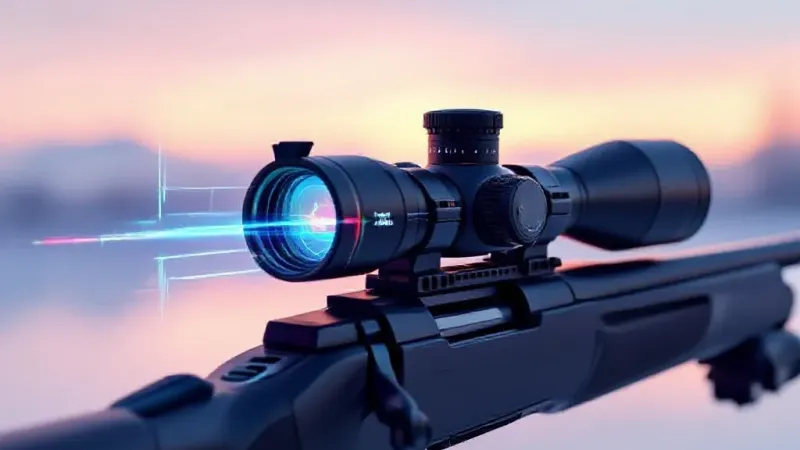
The most innovative aspect of the system is the FCS scope mount/display unit. Diverging from prior attempts to embed digital displays within optics, this module projects a digital aiming point directly onto the existing reticle of the shooter's chosen LPVO-style optic (1-6x, 1-8x, 1-10x) with either 30mm or 34mm tube diameters. This unit also contains its own Applied Ballistics software suite and can operate autonomously, accepting manual range inputs via a roll-wheel to generate a dynamic aiming point—a small chevron or T-dot—that adjusts vertically to represent the ballistic hold. An alignment reticle feature simplifies scope mounting and ensures precise projection alignment.
When fully integrated, the X4LRF connects to the FCS mount via cables. A single press of a remote button initiates the ranging and calculation sequence. During a recent evaluation, the system reportedly provided a short haptic vibration feedback, signaling completion of data processing. Immediately, the determined range-to-target appeared, and a green aiming point shifted position. For a target at 330 yards, the projected aiming point corresponded to a 1-mil low hold, which resulted in an impact. Similarly, at 405 yards, a 2-mils low hold was indicated and achieved impact. The system's straightforward operation was also noted when a relatively new long-range shooter successfully engaged these targets using the projected hold points.
However, the system's capabilities, while advancing integrated solutions, highlight a critical enduring challenge in precision rifle shooting: dynamic wind management. During the evaluation, while the system performed as expected at closer ranges, a new shooter experienced repeated misses "left" on a 550-yard target. This underscores that despite the semi-automated nature of such technology, "nothing consumer-grade is currently able to account for wind variables on the fly." The X4-FCS does offer manual input for wind speed and direction into its Applied Ballistics software. Yet, as noted, this process can divert a shooter's attention, and the real-time validity of such inputs is often questionable given the rapid variability of environmental conditions, particularly during a fast-paced PRS or NRL stage.
This limitation raises questions for experienced competitors. While the X4-FCS consolidates several tools, its reliance on a shooter's foundational understanding of ballistics remains paramount. For those already adept at interpreting rangefinder outputs and applying corrections to their reticle or turrets, the added value of the FCS projection module might be weighed against the persistent need for manual wind calls. The system targets a space where automation simplifies the ballistic solution, yet it cannot eliminate the fundamental skill of reading and compensating for dynamic wind shifts—a non-negotiable aspect of consistent first-round impacts in competitive long-range shooting.