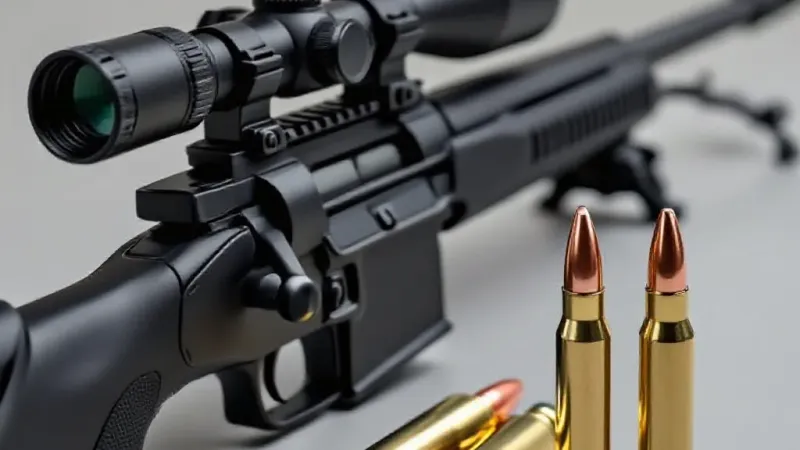
The M24 Sniper Weapon System holds an iconic place in the pantheon of precision rifles, revered for its consistent sub-MOA performance with purpose-built match ammunition. However, the question of its accuracy with standard full metal jacket (FMJ) ball ammunition, such as the widely available M80, has long been a point of curiosity for many enthusiasts and competitors considering potential emergency resupply scenarios.
A recent evaluation sought to shed light on this very topic, utilizing a used M24 rifle equipped with a fixed 10X scope. The rifle's baseline performance with match-grade ammunition was confirmed as excellent, with reported groups consistently under 1 MOA when firing factory Federal Gold Medal 175 Grain SMK ammunition at 100 yards. Furthermore, the rifle was noted to achieve even tighter groups, around 0.5 MOA, with carefully tuned handloads. This establishes a clear benchmark for the M24's inherent precision capabilities under optimal conditions.
The core of the evaluation involved testing the rifle with M80 Winchester 147 grain FMJ ammunition, a cartridge commonly encountered as a standard US Military ball round. Ten rounds were fired at 100 yards, yielding a reported average group size of 2.572 MOA. This figure represents a substantial departure from the sub-MOA performance observed with match loads, highlighting the profound impact of ammunition quality on the precision potential of a rifle like the M24.
Accompanying the accuracy data, muzzle velocities for the M80 rounds were recorded, averaging 2,803 feet per second with a standard deviation (SD) of 17.8. Interestingly, this measured velocity was noted to be remarkably close to the military's specified velocity for the M80, differing by only 3 feet per second. While the velocity consistency (as indicated by the SD) might suggest reasonable uniformity for ball ammunition, it did not translate into high precision in this M24 platform.
Ballistic analysis of the M80 147 grain FMJ, plotted against the 175 grain SMK (at 2,600 ft/s) and 168 grain SMK (at 2,756 ft/s), revealed interesting characteristics. Although the lighter M80 round proved less forgiving in wind conditions – an expected outcome given its lower ballistic coefficient – its trajectory for drop was reported to be surprisingly similar to the heavier match rounds. This phenomenon is attributed to the M80's higher muzzle velocity, which effectively compensated for its lighter mass over distance.
For competitive shooters accustomed to the exacting demands of PRS and NRL stages, where tenths of an MOA can dictate success, a 2.5 MOA rifle is generally deemed unacceptable for precision work. However, the evaluation concludes that while this level of accuracy is certainly not competition-grade, it remains a viable option in an emergency. The ability to engage targets, even with diminished precision, holds practical value when specialized match ammunition is unavailable and resupply is critical. This reported test offers valuable insight into the real-world performance envelope of a precision platform like the M24 when pressed into service with less-than-ideal ammunition.